Blue Denmark – Danish Blue – Finlandia – Blue Onion – Blue Willow – Chinese Traders – Old Chelsea Blue – Yuan
Blue and white porcelain patterns endure because they unite beauty and practicality. Their brilliant contrast, durable pigments, and centuries of cultural prestige have made them a universal art form — one that tells the story of global exchange, artistic innovation, and timeless taste.
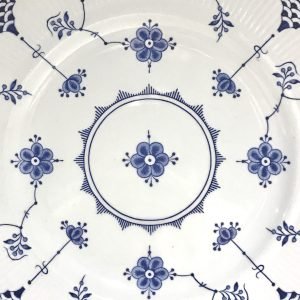
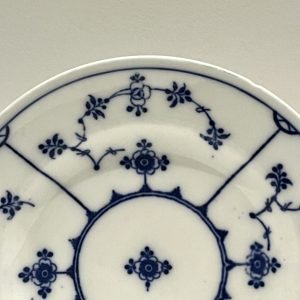
Blue Denmark China Pattern
Origins: Denmark, Royal Copenhagen pattern called “Blue Fluted”.
English manufactures who produced “Blue Denmark” ironstone and porcelain: Furnivals, Masons, Franciscan, Johnson Brothers.
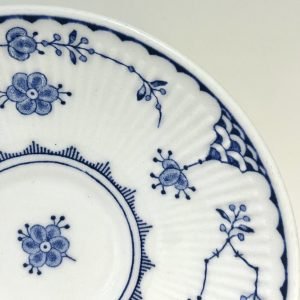
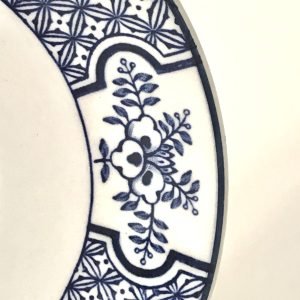
This is one of the most iconic patterns originated in China, adopted by German & Danish porcelain makers and later on by English manufactures. It features floral elements along with linear geometrical shapes. Which remain remarkably relevant even in modern times.
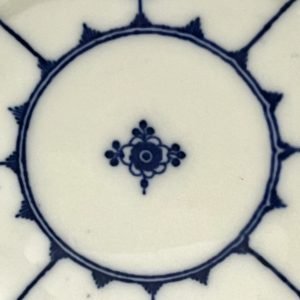
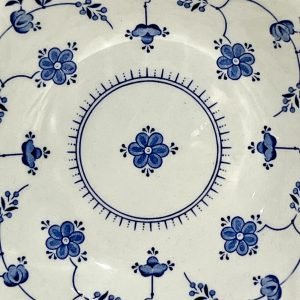
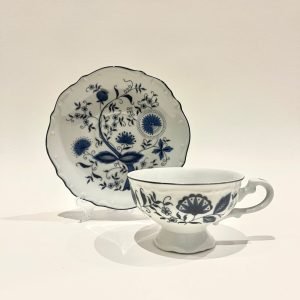
This is a variation of an English pattern called “Blue Denmark”. Both patterns have almost identical lines and dimensions. Main differences can be noticed in floral elements and absence of “mussels” which are replaced with similar circular elements.
English manufactures who produced “Danish Blue” ironstone and porcelain: Mintons.
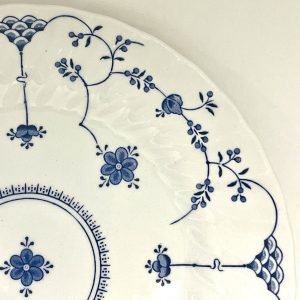
This design is a variation of the “Blue Denmark” china pattern, featuring subtle modifications, most notably along the edges, where the original linear motifs are replaced with softer, more floral vine elements.
English manufactures who produced “Finlandia” ironstone and ceramics: Myott & Churchill.
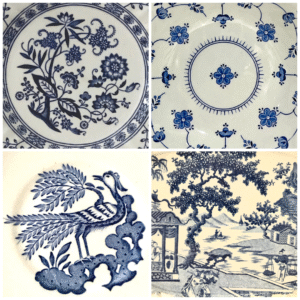
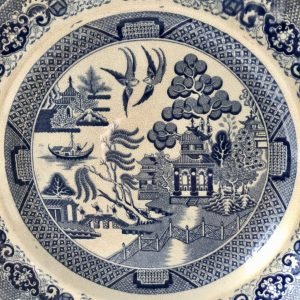
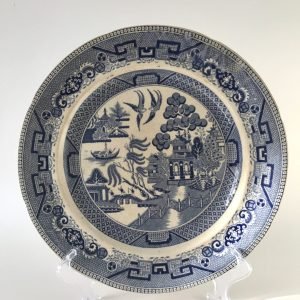
This is one of the most famous blue and white porcelain patterns around the globe. It typically depicts an idyllic Chinese-inspired scene with a pagoda, willow tree, bridge with figures, and flying birds. It remains one of the most recognizable and enduring motifs in pottery and tableware.
It was used by numerous manufactures across Europe, such as Spode, Wedgwood, Minton, Royal Doulton, Johnson Brothers and many others.
Blue Onion China Pattern
Origins: German pattern designed by Meissen
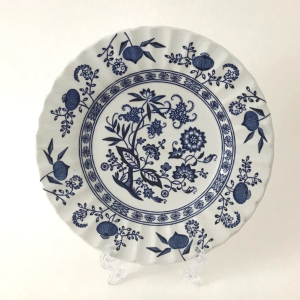
The Blue Onion pattern originated in Meissen, Germany, around 1740. Inspired by East Asian motifs, the pattern features stylised flowers, fruits, and leaves—often mistaken for onions, though they were originally meant to represent peaches and pomegranates. Later it was copied by many other makers such as Royal Copenhagen, Hutschenreuther, Spode, Wedgwood, Minton, Johnson Brothers and many others.
Though the design remain very simular the name of the pattern may vary. As an example J&G Meakin & Johnson Bros used to call it “Nordic Blue”.
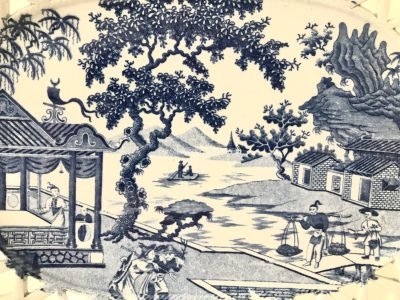
Origins: chinoiserie English pattern designed for Andrew Stevenson in early 19th century.
The design is a finely executed blue transfer print depicting a lively Chinese trading scene. In the foreground, figures carry baskets of produce across an arched bridge toward a river landing stage, where boats await to transport their goods. The composition is framed by an idyllic landscape of stylized trees, distant mountains, and pagoda-like structures, evoking a romanticized vision of Chinese commerce and scenery popular in early nineteenth-century Staffordshire pottery.
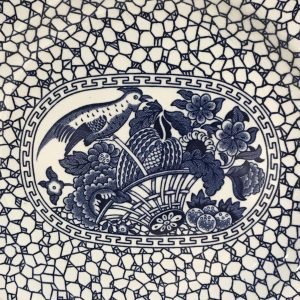
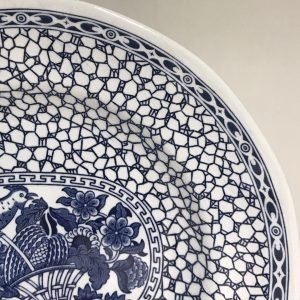
The “Chinese Bird Pattern,” also known as “Bird and Basket,” was first produced by William Adams in 1780, during a period when Asian porcelain exports were becoming increasingly popular. In response to this trend, Adams sought to introduce a new design that would compete with and emulate the highly sought-after Chinese style. It features an elegant bird perched beside a woven basket overflowing with flowers, framed by a decorative floral border.
English manufactures who produced “Bird & Basket” ironstone and porcelain: William Adams & Sons, Enoch Wood & Sons, Clews Brothers, Ridgway, Davenport.
Origins: This is a classic English transfer-printed design, best known from Furnivals of Staffordshire, England. Produced primarily in the 20th century. It reflects revival of Georgian and Regency English taste, when manufacturers reinterpreted classic designs for modern domestic life.
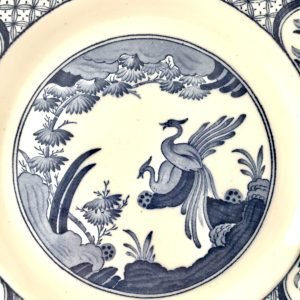
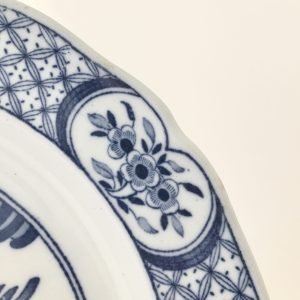
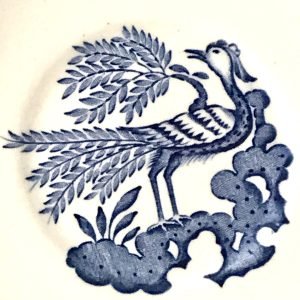
In the center of the design stands one or more stylised birds — often perched among rocks and foliage. They are surrounded by leafy plants and sometimes floral elements. This central bird motif is framed by a U-shaped or circular medallion, which in turn is bordered by a rich lattice and floral panel border. The interplay of the spirited bird(s) with the leafy setting gives the pattern an exotic, chinoiserie‐inspired charm.
The Yuan pattern was designed by Frederick Rhead for Wood & Sons and was first registered in 1916 (Reg. No. 656368) as a reproduction of an “oriental design from the 13th C Yuan dynasty (1280-1367)”. Visually it is a classic blue-and-white transfer-print tableware pattern: typical pieces feature birds (sometimes a pair, sometimes a single) among foliage, framed by decorative borders in cobalt blue. The pattern enjoyed remarkably long production: from around 1916 through the 1980s, making it one of the longest-lived and most successful designs from Woods.